The Boat We Build Together
Feb 27, 2026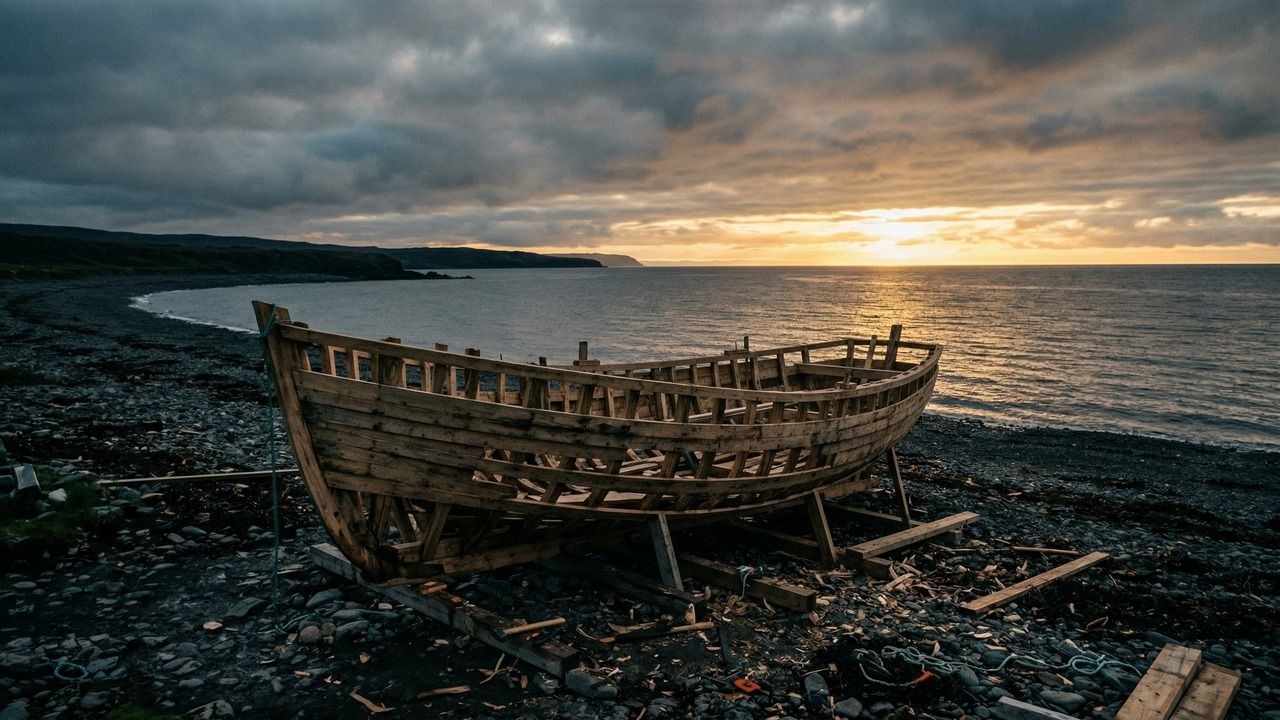
Why carefully constructed communities are the most important thing we can create in a digital world
There is something distorted and inflated, and we all feel it.
Scroll through any feed for ten minutes, and you can taste it — the hollow aftertaste of connection that isn't. Thousands of followers, dozens of group chats, notifications piling up like leaves in a gutter. We are more networked than any generation in human history, and somehow more alone.
I'm not pointing fingers. I've been in these spaces. I've never worked inside tech or inside someone else's company — I've been an entraprenuer since college, building things from the outside, which means I don't think the way most people in these industries think. But I've spent real time in digital communities — meme-coin Discords, self-help groups, creator circles, crypto communities, and forums that burned bright for six months and then went dark. I've watched communities form around missions and leaders and content — and I've watched most of them collapse the moment the leader lost energy, the content dried up, or the first real conflict surfaced.
The pattern is always the same. A group comes together with enthusiasm. Everyone is polite. Everyone agrees. It feels electric — like something real is forming. Then someone says something uncomfortable. A disagreement. A tension that can't be smoothed over with an emoji reaction. And instead of leaning in, the group scatters. Back to the safety of surface-level engagement. Back to the community's performance without its substance.
And here is the part that bothers me most: almost every community I've been in lives and dies by its leader or its content. People join as long as there is value being handed to them. They consume. They extract. And when the value stream slows, they leave. Almost nobody shows up to contribute as who they are. Almost nobody brings the value — they wait for it to be delivered. Communities function like audiences with membership fees.
Scott Peck called this pseudo-community. He mapped the entire cycle decades before social media existed: groups start in surface harmony, descend into chaos when real differences emerge, face a painful emptiness when ego is stripped away — and only then, if they survive all that, do they arrive at true community. Deep listening. Real trust. Collective intelligence that none of the individuals could have reached alone.
Most digital communities never make it past the first stage. They are dressed up as tribes but function as audiences. They have members but not relationships. Channels but not conversations. Content but not culture.
This is the dark part. This is what is real.
And it matters more than we think.
Because we are entering an era where the ground under every institution is shifting. Intelligence is being industrialized. AI systems can now do in seconds what took teams of knowledge workers months. Energy is getting cheaper. Labor as we know it is being redefined. The economic models that shaped the last century — scarcity-based, production-measured, shareholder-first — are groaning under pressures they were never built to absorb.
Ray Dalio mapped the cycles. Great powers rise, consolidate, decay, and are replaced. Raoul Pal pointed to 2030 as the moment when the convergence of AI, blockchain, and abundant energy makes the old economic rules unrecognizable. Peter Diamandis talks about "solving everything" — using industrial intelligence to crack disease, energy, and materials science. Kurzweil charted the exponential curve and said the singularity is not a distant fantasy but a near-term reality. I would argue that we are here.
They are all pointing at the same horizon. And they are all, in their own way, missing the same thing.
Technology can transform industries, domains, and specific problems. But we can’t rely on it to evolve us. That work is ours to do — deliberately, and with intention.
We are building godlike machines with stone-age nervous systems. We have the capacity to automate the "how" of nearly everything — and almost no shared infrastructure for the "who." Who are we becoming? What do we value? How do we coordinate when the old rules stop working? How do we stay human in a world that is accelerating past our ability to predict what happens next?
These are not philosophical luxuries. They are survival questions. And the answer — the only answer that has ever worked across civilizations, across centuries, across every tradition that left something worth inheriting — is community. Not the word. Not the brand. Not the Slack channel. The real thing.
Real community is the hardest thing to build. That's why almost nobody does it.
Real community requires you to show up as you actually are — not the curated version, not the professional persona, not the optimized personal brand. It requires conflict. It requires sitting in the discomfort of disagreement with people you've committed to, and choosing to stay instead of scroll away.
Peck described the stage before true community as "emptiness" — a space where each person lets go of their need to fix, control, convince, or perform. It looks like failure. It feels like loss. And it is the only doorway to the thing everyone says they want but almost no one is willing to earn.
I've been through something like the dark side of this personally. I was born two months early, brought back to life by the hands of strangers. I grew up with ADHD in the basement of a Catholic school, building worlds in my head that nobody else could see. Every time I tried to share what was inside me, I learned something about connection — and about what it feels like when that connection doesn't land. So I know what avoidance tastes like. I know what it means to have a voice and be afraid to use it.
And I know that the people who have done the deepest inner work — who have faced their own chaos and emptiness — are often the ones most reluctant to be visible. The narcissistic networks reward the loudest, the most polished, the most willing to perform. The people with real substance often sit it out because the cost of engagement feels too high.
This is backward. This is the imbalance we need to correct.
So what does a carefully constructed community actually look like in a digital space?
It starts with a promise. Not a mission statement carved into a boardroom wall. A living, dynamic promise — what I call a Compelling Aligning Promise, or CAP. It is specific enough to pull action, meaningful enough to matter, and shared enough to align people around a common direction. The individual who makes the promise and the community that holds the promise operate in parallel. The founder is not above the community — they are the first member. Their model of personal alignment is the community's foundation.
Beneath that promise lives identity — values, energy, trajectory. Who are we? How do we show up? Where are we heading? This is not brand language. This is the honest accounting of what we actually stand for, the energy we bring into rooms, and where our current behavior is really taking us. When identity is clear, it becomes a filter. The right people feel it and lean in. The wrong people self-select out. No sales pitch required.
Then comes voice — authentic, resonant communication. Not marketing. Not content strategy. The actual sound of a community speaking its truth. Marshall Ganz calls it the story of self, the story of us, and the story of now. Seth Godin calls it the smallest viable audience. I call it the difference between attention and belonging. You don't need millions of followers. You need the right people hearing the right signal.
Then priorities. Then the network structure. Then rituals — the daily and weekly practices that turn a group of strangers into a culture. Then, at the root, individual ownership — each person doing their own work, taking responsibility for their own growth, feeding what they learn back into the collective.
Seven layers. CAP, VET, ARC, MAP, NET, RIT, OWN. From the crown of shared purpose to the root of personal accountability. The same architecture works for a person, a startup, a community, and an economy. The same geometry at every scale. Fractal alignment.
I want to be honest about something: I have not successfully built a community. Not yet. I've studied this, researched it deeply, lived inside communities that didn't work, and spent years developing a framework for how it could work. But the proof is still being written. I'm building now — with Corvia, an AI music community exploring emotional development, and with Somabase, a platform for human-technology collaboration and emotional maturity. Both are early. Both are laboratories for the hypothesis that intentional community, carefully constructed around shared values and honest practice, is the most powerful structure humans have for navigating change. The foundation I'm building runs deeper than I can explain in a single blog post. It will take time and context to show. But I'd rather be honest about where I am than pretend I've already arrived.
Here is where the light breaks through.
When a community gets this right — when it moves through pseudo-community and chaos and emptiness and arrives at the real thing — something extraordinary happens. The collective becomes smarter than any individual in it. Problems that seemed unsolvable from the inside become obvious from the shared perspective. People who feel lost find direction. People who feel voiceless find a frequency that is unmistakably theirs. Ventures emerge not from market analysis but from genuine need, identified by people who trust each other enough to be honest about what is missing.
The Beatles didn't just make music. They created a cultural field that millions of people stepped into and were changed by. That field was community — unstructured, messy, emergent, but real. Imagine what becomes possible when we apply everything we've learned about human development, organizational design, tokenomics, AI collaboration, and consciousness research to intentionally build that same kind of field.
Imagine communities where contribution is tracked and rewarded — not through likes and followers, but through actual ownership stakes in the shared infrastructure. Where the economics reflect the values. Where blockchain makes it possible to distribute agency rather than concentrate it. Where the definition of value shifts from what you produced to what you contributed to the flourishing of the whole.
This is not utopian fantasy. The Economic Space Agency is building protocol infrastructure for exactly this kind of postcapitalist coordination. DAOs have already demonstrated that decentralized governance can work — imperfectly, messily, but really. Tokenized ownership turns shared infrastructure into shared income. The pieces exist.
What has been missing is the human readiness. The emotional maturity to hold disagreement without fragmenting. The technological maturity to use these tools intentionally rather than compulsively. The economic maturity to value contribution over extraction.
Three maturities. Three directions the entire global economy needs to grow. I've spent a lot of time mapping this. Nearly everything we spend money on traces back to three primal forces: how we present ourselves and develop as people — our identity, our bodies, our growth. How we alter our experience — entertainment, substances, social media, anything that shifts our state of consciousness. And how we capture, store, and exchange value — the entire financial system, from banks to bitcoin. These three forces — identity, experience, and value — account for almost everything. When you look at where the money actually flows in the world, you see a $115 trillion economy built overwhelmingly around these drives. The question is whether we keep feeding them unconsciously or start maturing them deliberately. Emotional maturity ends wars. Technological maturity ends addiction and distraction. Economic maturity ends poverty and exploitation. The sequence is not optional — you cannot build a mature economy on an emotionally immature foundation, and you cannot use technology wisely until you have examined your relationship to the tools that shape your consciousness.
We are in the water right now.
The waves of technological disruption are coming whether we are ready or not. The old boats — the corporations, the institutions, the governments designed for a slower world — are taking on water. Some will adapt. Many will not. The question is not whether change is coming. The question is what vessel you are in when the waves hit.
The boat is community. Carefully constructed. Values-aligned. Honest about the chaos. Willing to pass through emptiness. Built not for speed but for resilience. Crewed not by employees but by owners — people with real stakes, real voices, real accountability to each other.
This is the thing I am dedicating my work to. Not because I figured it all out — I am figuring it out in real time, messily, publicly, with the same fears and doubts as everyone else. But because the alternative is worse. The alternative is drowning alone in a sea of information, clutching a phone full of followers and wondering why none of it feels real.
If you are reading this and you feel the pull toward something more honest, more intentional, more human than what the platforms are currently offering — know that you are not alone. The avoidant ones, the quiet ones, the people who have done the inner work but haven't yet found a space worthy of their voice: you are exactly who we need. The narcissistic networks have had their turn. It is time for the people with substance to show up.
Not to perform. Not to optimize. To build something real. To construct the community carefully — with shared values, clear direction, honest communication, and the willingness to stay when it gets hard.
That is how we ride the waves.
That is the boat we build together.
Erik Horbacz is the founder of The New VC, a venture community lab exploring the intersection of human maturity, technology, and community-first business. He is building Corvia (an AI music community for emotional development) and Somabase (a human-technology collaboration platform), and writing about what it takes to stay human in an accelerating world.
Unleash creativity, connect through music, and shape the future—start your journey with Corvia today! 🚀🎶.
Stay connected with news and updates!
Join our mailing list to receive the latest news and updates from our team.
Don't worry, your information will not be shared.
We hate SPAM. We will never sell your information, for any reason.